Saturday, June 13, 2020

Afternoon at the Park


Looking back at it now, several things stick out: the way that near-invisible dimple showed up on your right cheek when you smiled wide enough; the way the skin in your arms felt as I caressed it; how adorable you looked standing against those old houses; how I found myself staring at your face while you talked.


I was surprised at how many emotions I felt in one afternoon.


There was some trepidation, for sure. There’s always that when you’re meeting somebody for the first time. But I had to get past that quick because there was no doubt I was gonna go through with it—to finally see you in real life after weeks of torturing myself with best and worst-case scenarios.


And then there was anticipation—the thrill of knowing you were going to be there; nervousness—that first few minutes in the car when it suddenly dawned on me that this was really happening; the feeling of being relaxed and at ease—how easy and natural you made it all feel; joy—for bringing life to something as seemingly generic as a walk in the park; and several other things I’d like to keep to myself, but I suspect you already know.


When you told me that story of our “accidental” collaboration, I was intrigued. It was completely unexpected, and something I would’ve taken as a sign, if I believed in such things.


When I became aware of your politics, and how passionately you used your art to convey your beliefs, it wasn’t a turn-off. On the contrary, I admire how much of yourself you put out there; it’s something I could only wish for myself. (The fact that your stand on most issues align with mine is simply a happy bonus).


And when I realized you were funny—the kind of funny that had me chuckling at the glow of my phone at 2 a.m., and the kind of funny that made me suddenly go quiet and smile during lunch with the people in my household, making them question my sanity—that was a lightbulb moment, too. You’re quick-witted and acerbic—you could make a joke out of a corny pun as easily as a reference to a TV show or movie we both enjoyed. You’re the exact opposite of boring, and who wouldn’t want that?


These are all reasons for me to keep reaching for my phone and checking for new messages from you, but let me tell you when you had me: when we finally met and you turned out to be exactly who I thought you were—gentle, interesting, a little awkward, lovely company, and even cuter than you are in pictures.


I tested the waters and honestly wasn’t expecting much, but meeting you has been the highlight of my pandemic experience. You’re living proof that rewards await those who don’t give up.


I’m not sure what lies ahead, to be honest. I'm not even sure how you feel about me. But if that afternoon at the park is any indication, whatever happens is going to be amazing, meaningful and fun. And I can’t wait to see you again.


Thursday, April 9, 2020

Unforgettable South Africa

Me and Madiba


The sky is blue almost everywhere else on the planet, but in South Africa, somehow, the hue is more pronounced. My first view of the outdoors after clearing immigration and passing through the double doors of the OR Tambo International Airport in Johannesburg was of a cloudless, deep cerulean sky that was dazzling in its intensity. It was a fitting welcome to a country and a continent that I was visiting for the very first time.

First photograph of South Africa, just outside the airport in Johannesburg


“The first Europeans arrived in South Africa in 1652,” said the guide, a pleasant old chap named Hendrick. Humans, of course have inhabited the lands in and around the southern tip of the African continent for hundreds of thousands of years. In fact, some of the oldest archaeological evidence of the existence of people anywhere in the world is in Gauteng province, leading to the area being nicknamed the Cradle of Humankind.

As the bus traversed the plains of Johannesburg en route to Sun City, Hendrick mouthed off a few more facts about South Africa: the population stands at 54 million, it was the Dutch East India company that established the first European settlement near Cape Town, and that there are 11 officially recognized languages in the country.

“The Flemish language was the basis for communication,” the guide said. “It was called ‘kitchen language’ because it was often spoken behind closed doors. Dutch was the official language in the beginning, but settlers from other European countries like Germans, British and Russians  assimilated themselves and the language was later called Afrikaans, which is a mixture of Dutch-Flemish plus other languages.”

Melman wanted a selfie. How could I say no?


How many times can you pet lion cubs in your lifetime? 


About two hours later Sun City appeared on the horizon, like a mirage rising out of the basalt soil plains surrounding the Pilanesberg, an extinct volcano that last erupted millions of years ago. Home for the evening was the Palace of the Lost City, a sprawling luxury casino and resort considered the crown jewel of Sun City. The place inspired wonder and awe like any multi-million dollar resort property in the middle of the African plains would. There’s a pool with a sandy beach, a maze, and a bridge that simulates an earthquake every hour. It was the base upon which the group set off to explore the adjacent Pilanesberg Game Reserve very early the next morning.


My room in the Palace of the Lost City


Took a walk around the property. I kinda still like this photo. 


Sun City is a fancy resort and casino in Johannesburg


The grand staircase and lobby of the Palace of the Lost City


“Much of the world’s platinum, about 80 percent, is mined from around this area,” the guide said onboard the 4X4 vehicle especially outfitted for game drives. Opened in 1979, the Pilanesberg Game Reserve was an old farmland that became the site of the world’s biggest relocation of animals since Noah’s Ark. “Operation Genesis involved transferring over 6000 animals throughout 58,000 hectares of lush plains and valleys,” said Hendrick. “Now there are about 10,000 animals here.” 

Any apprehensions about not seeing any animals immediately vanished as one by one, they appeared: impalas, antelopes, zebras, giraffes, lions, hippopotamuses and elephants. There was even a slight traffic jam when a herd of elephants blocked the road as they lazily fed on trees and bushes. For someone who grew up in the concrete jungle of a big city, it was a scene straight out of a childhood dream.  


Elephant traffic jam


Like a boss


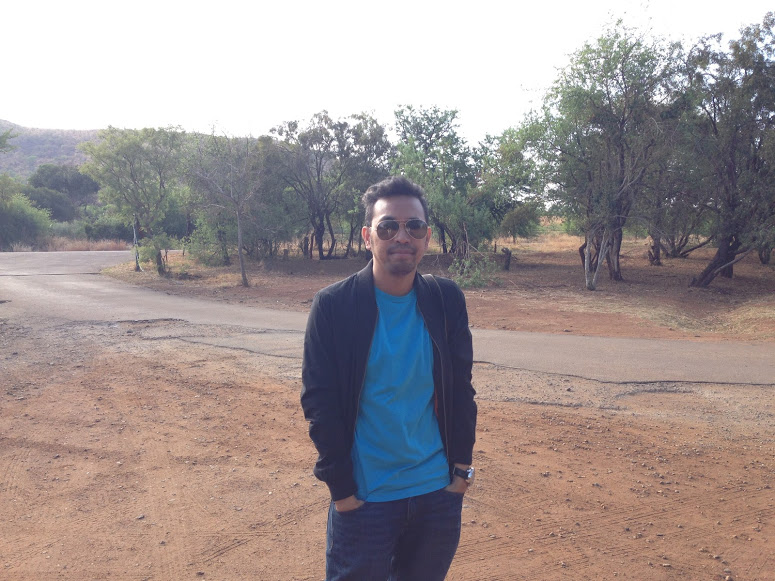
Me in the plains of Africa


One interesting fact about South Africa is that it does not currently have just one capital city. The headquarters of the three branches of government are located in three cities: executive in Pretoria, judiciary in Blomfontein, and legislative in Cape Town. 

Pretoria was the next stop in the journey. About three hours drive from Johannesburg, the city developed rather quickly in the 1850s when government and church leaders decided to open a church in what used to be bush country. Today the city is also nicknamed the City of Jacarandas for the roughly 155,000 jacaranda trees that line its streets and avenues. Similar to the chery blossoms of Japan, the trees lend the city a magical, fairy-tale like atmosphere when they bloom in October and November.


Pretty jacaranda trees

Larger-than-life Nelson Mandela


There was time for a quick stop at the Union building, where the main attraction was a nine-meter tall bronze statue of South Africa’s most famous son, Nelson Mandela. Inaugurated just a couple of weeks after the democracy icon’s death in 2012, the statue stands in the same place where Madiba (Mandela’s nickname) was inaugurated as the country’s first democratically elected president in 1994.

The two-hour flight to Cape Town via South African Airways was pleasant and breezy. It was already dark when the plane touched down, so there was only a ghostly silhouette of the city’s famed Table Mountain. The grand view had to wait until morning. 

The guide, whose name was Muhammad Ali, also shared interesting information about the city he calls home. “Inhabited by 4.5 million people, Cape Town is about four and a half times bigger than Singapore,” he said. “It was the Portuguese explorer Bartholomew Diaz who first reached the Cape Of Good Hope, although back then his men called it the Cape of Storms. Years later, the King of Portugal told Vasco Da Gama, ‘If you can successfully pass these stormy waters, you have a good hope of making it to India.’”


I forgot the name of our first hotel in Cape Town, but the lighting sure was memorable


Bucket list moment


There is a marker that now stands in the craggy hills of the Cape of Good Hope, advising visitors that they have reached the most southwesterly point of the African continent. North across the lookout is Cape Point, a promontory with a spectacular view of wild, restless sea. It has been said that this is where two mighty oceans meet—the Atlantic and Indian—but experts have said that it is only the former that one sees. Still, the view here is nothing short of breathtaking, with white sea foam that forms when waves slam into dark cliffs, and waters the color of emerald stone that turn to deep, dark blue farther out into the horizon.


Took a while to get up here

But the views were worth it

Wanted to stay longer


If Johannesburg is rough, uneven and dynamic, Cape Town is its more laidback, well-mannered and gorgeous sister. Nicknamed Mother City, it was named best place in the world to visit in 2014 by The New York Times, and for good reason. There is an air of gentility and warmth here as one walks its streets, its people always ready with a genuine smile. A quick excursion to one of its bars revealed a lively nightlife scene comparable to any other big city.


Had time to visit a colony of penguins


So cute


Here I am at a beach in Cape Town


Seals sunning themselves on an island just off the coast of Cape Town


Marga and I were the only two Filipinos on the trip


Just goofing off


Watching over the city is Table Mountain, which Ali said is actually a mountain range.  Formed over 270 million years ago, its presence is akin to having a world wonder on the doorstep every single day. “The mountain range has more flowers per square area than any other place on earth,” Ali said. It is possible to go up Table Mountain through a cable car, with a rotating floor that provides everyone inside 360-degree aerial views of the city. 


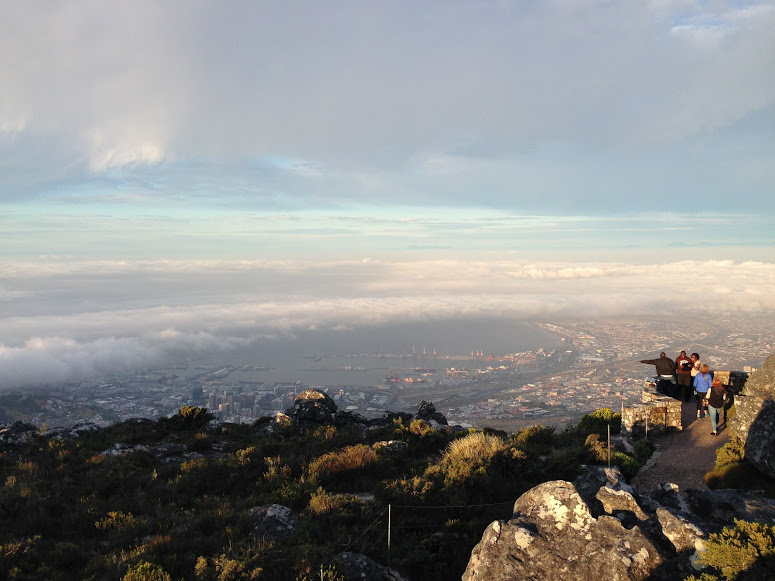
Making it to the top of Table Mountain in Cape Town was one of the most unforgettable travel moments of my life, and I made sure to write down a few thoughts while I was there


View of the city from the top of Table Mountain


A sea of clouds


I'll never forget this experience


So here's another angle


One of the most spectacular sunsets I've ever been fortunate to witness in my entire life. It's still the cover photo on my Facebook after all these years


Once on top, it is difficult to overstate the beauty and majesty of the landscape. The blue sky was beginning to give way to deep orange and amber and the setting sun bathed everything in a kind of glow that made believing in the existence of a Higher Being  much easier. This was the Cape Town, and indeed, the South Africa that sticks most in my memory: a kaleidoscope of shapes and colors that can be found nowhere else in the world.


Went to a dinner and show later that night. Of course I got recruited to perform onstage


My friend from Manila Erwin and his wife were there in Cape Town the same time we were so we headed out to experience South African nightlife


Went to this bar somewhere in the city. Everything's a blur now. I must've been exhausted that day


Breakfast with a view of Table Mountain


Last photo. I would love to come back to South Africa

This is a slightly edited version of a story that originally came out in Lifestyle Asia magazine in 2015.

Tuesday, February 18, 2020

I'm Not Okay


Back in my 20s, I never really thought about how life was going to go when I reached a certain age. I didn’t have a Lelaina-Pierce-I’m-really-going-to-be-somebody-by-the-age-of-23 life plan. But, after you’ve lived long enough, you’d think life would at least give you a break and things would make sense. Stuff you worried about back then ought to stay there—in the past—and you think you’d be well-equipped by now to handle things, or your life would just be so on point that there would barely be any issues at all.

Like right now. I am not okay. I am the complete opposite of okay. We’ve been taught our whole lives to maintain an aura of invincibility, to never acknowledge vulnerability or admit to feelings of weakness or despair. But I can’t do it anymore. I’m exhausted putting on this façade of normalcy and appearing like I’m keeping everything together.

I’m sure I’m not the only one. In fact just a few months ago, two close friends broke down in front of me just one day apart and laid out all their issues in between nonstop tears. I dropped everything of course to be with them, and I’m glad I did, even though I’m still unsure if I was of any help beyond staring at them stoically and mumbling generic words of encouragement. I was sympathetic, but dispensing practical advice is not one of my strong suits.

Right now, I feel like I’m in that position myself. I go about my day as usual, but there are moments when I feel like I’m seconds away from crumbling. I do the things that needs to be done in order to maintain the appearance of being a functioning, productive member of society, but there is a large, gaping hole inside that I have no idea how to fill.

I hesitate asking help from anyone because I know—I KNOW—people are fighting their own demons. Nobody can afford to be co-dependent, least of all the members of my immediate circle. No way can I bring it up with my family—my mom has enough things to worry about without me adding some unknown, unidentifiable malady adding to her list. As for friends—well, it’s mostly the same thing. Plus the fact that I sometimes feel that the things eating me up inside can’t possibly compare to what they’re going through. It’s not a competition for who has the biggest problem, I know,  but sometimes I feel like it is, and always I’m the loser who just has to keep his mouth shut because worse things are happening to other people just as ill-equipped to handle them.

Sometimes I hear both sides of the conversation. I’ll be told to “suck it up,” “just keep pushing,” or even “grow up.” And my favorite: “This, too, shall pass.” Well, you know what? If you’re asking me to be mature, to accept what is and let go of what could have been, to be quite frank, I don’t know if I can do that right now. I don’t need to hear platitudes or some hackneyed words of comfort. I’d rather stare at the ceiling than hear choruses of “It’ll be fine,” or “You’ll get over it.”

I don’t know what I need.

All I know is that I feel like crap. I’m so tired of the routine of everyday life, to keep taking up space in this world and for what? What are we here for anyway? Funny how I’ve suddenly descended on existentialism, when I don’t even have the energy to follow through. Who cares? I certainly don’t.

It’s too easy to lay the blame on people—to point at someone and say, “You. You’re the trigger.” But the truth is, they may have just uncovered what was already there in the first place. Even I realize that you can’t fault other people for how they make you feel. People will do what they want to do—but how you react, that’s all on you.

It’s all on me.

I wasn’t being cynical or facetious when I said “This, too, shall pass,” is a favorite (okay, maybe I was, a little bit). It’s cliched because it’s true. But right now, I can’t muster the enthusiasm to look forward to the day that, this—whatever it is—passes. Because it’s happening now and I’m in the midst of it. It’s raw and it’s real and no, I don’t feel like it’s an option to just “snap out of it.” It may have been that way in the past, but this time feels different. I don’t know why.

But I’ll keep up that veneer of…what? Strength? No. More like nonchalance. I'm so tired, but I’ll still go to work, I'll still reply to people’s messages, still laugh at their jokes, and still feign interest at things hurled at me. Because at this point, what's the alternative?

Saturday, January 18, 2020

The Magic Of Damien Rice

Many of the stories I've written over the years are scattered all over the internet. Some of them I still kind of like and would like to preserve, so I'm reposting them here on my blog.

Here's my account of the first time I ever saw Damien Rice perform live. The original post can be found here. 


When Damien Rice walked onstage at Singapore’s Star Theatre last Saturday night, the venue was pitch black. The spotlights didn’t immediately flood the stage as expected, even after he started on his first song. For a few minutes, all audiences could hear was a faceless, disembodied voice wailing “Older Chests.”

I couldn’t help but think he was making a statement. Perhaps it was a way to remind the crowd of the first time they heard Rice’s music: on the radio, on bootlegged mp3s, on CDs. Having him right there in person, in the flesh, was certainly a treat, but for a majority of those who chose to part with their hard-earned money to catch his show, including me, the opening was a throwback to the days when we listened to his music, often alone and in the dark, grappling with emotions as varied as confusion and anger, sadness and grief.

Most music fans have a list of artists they’d like to see perform live. I’m lucky I’ve ticked off a few in mine: John Mayer, Keane, Snow Patrol, Joshua Radin, Sting, The Lemonheads, Aerosmith, Howie Day and many others. But Damien Rice has always occupied one of the top slots in my own concerts-to-attend-before-I-die list. It began almost immediately after a friend, Pedi, introduced me to him via a bootlegged copy of his debut album O.

“I really enjoyed the Damien Rice CD,” I told Pedi via email, dated 16 November 2003. “I think it’ll be living in my CD player for a while. Favorite tracks: ‘Cannonball,’ ‘Cold Water, ‘Amie,’ and ‘The Blower’s Daughter.’”


Since then Rice has been a fixture in my musical diet. The thing with his music though is that it’s not exactly for everyday consumption. You probably could, if you really wanted to, but his brand of melancholic, folk rock lends itself well to moments of sobriety and introspection. He’s not the first name that comes to mind at rave parties, beach trips, or your fraternity’s all-nighter. His songs don’t exactly suggest joy, sunshine, and the promise of happy ever after.

Instead, the music of the fortysomething Irishman seems to go well during our darkest, gloomiest moments. It’s the soundtrack to those episodes in our lives when we’re wounded or scared. We put him on when we’re feeling anguished or despondent, when the tears fall and our insides hurt. He doesn’t celebrate with us when we’re happy so much as he commisserates during heartaches and heartbreaks. Sometimes we play his songs just to temper our relative cheer with a dose of soul-stirring reality. His music is catharsis; sad and painful at times, but always leaving us feeling grateful and hopeful.

Which is why I didn’t hesitate to fly to Singapore when he announced a stop there as part of his My Favourite Faded Fantasy tour. He was just in Singapore late last year as part of the lineup for a music festival, but as far as I can remember, this is his first solo show in the Lion City since 2006.

From my front row seat, Rice was almost luminous in his loose collarless shirt, suspenders (or braces as the Brits call them) and khaki burlap trousers. With his acoustic guitar, he launched into one song after the other with hardly a word to the audience: “Delicate,” “My Favourite Faded Fantasy,” and “9 Crimes.”


Finally he addressed the audience with a humorous allegory about a 13-year-old boy who receives a million dollars everyday but is told not to do anything about it. The punchline (which I won’t reveal here; you had to be there) got a laugh out of the audience, belying the image some might have of him as a staid, ultra-serious singer-songwriter. He then segued to fan favorite “The Professor & La Fille Danse.”

After “I Remember,” Rice couldn’t help issuing a gentle reminder about concert etiquette directed at those with overactive bladders. “Maybe wait till after a song before you get up to go to the toilet?” he said, drawing claps of approval from the crowd, and perhaps sheepish grins from those already up.

“What’s the one thing in common with all your romantic relationships?” he asked. “You.” Rice then revealed how he himself has been staying away from romantic relationships for two reasons. “First, because you don’t want to feel bad about yourself. You’re not a failure if you didn’t do anything. And the other reason is fear.”

At this point I realized how much Rice transcended the stifling limitations of a one-man acoustic show. It’s so easy to bore an audience when you have nothing else but your voice and a guitar, but Rice made smart, efficient use of both of those instruments to deliver a stunning, mesmerizing show. He was such a powerful presence that you couldn’t tear your eyes away from him even for a second. The lighting design helped, too, with dramatic, strategically placed beams enhancing the intimate atmosphere inside the 5,000-seat theater.


In a previous interview for music site Bandwagon.asia, Rice mentioned that he likes walking out onstage without a plan or a setlist. When he asked the audience what they wanted to hear, he was deluged with a ton of requests. “I heard ‘Accidental Babies,” he said, and then proceeded to sing the track from his latest album.

After “Volcano,” he moved to a small set-up on one side of the stage, where he poured himself shots of whiskey while plaintively warbling “Cheers Darlin’” accompanied by a pre-recorded track.

“Fuck romance,” he spat out at the end of the song.

I yelled out “Amie!” when he asked again what people wanted to hear. His rendition of the track from O was as beautiful as I expected, forceful and elegant. His next song,  “It Takes A Lot To Know A Man,” was a showstopper. He used samples and delay pedals to add a rich layer  of dynamism to the end of the regular set. One after the other he recorded an acoustic guitar track, electric guitar, clarinet, percussion, and another acoustic guitar, then mixed them all together in a gut-busting performance that no doubt left many in the crowd picking their jaws up from the floor.

The encore came soon enough. I couldn’t help but scream “The Greatest Bastard,” which, thankfully, he was kind enough to oblige. Security had their work cut out for them when Rice asked audiences to come closer for his final three songs. “Cannonball” was the first song of his that I heard over 13 years ago and it was especially moving to be just a few inches away from him as he sang those unforgettable words: “Stones taught me to fly/Love taught me to lie/Life taught me to die/So it’s not hard to fall/When you float like a cannoball.”


The profanity-laced chorus of “Rootless Tree” is particularly memorable, sending audiences into an energetic sing-along.

Rice’s big finale is also perhaps his biggest “hit.” Most audiences were introduced to him when “The Blower’s Daughter” was used in the Mike Nichols’ drama “Closer.” Fittingly, he used the track to close out the show.

It was likely that last song melted away any vestiges of doubt anyone might have had about the potency and sheer magic of Damien Rice. “The Blower’s Daughter” is Rice himself—intensely personal yet undoubtedly universal. Lots of other people can sing and play guitar, but the way Rice does it makes one believe how connected we all are despite all our unique experiences and sensibilities. And I think that’s what makes him so special.

Walking out of that theater, I was filled with an overwhelming sense of gratitude for having witnessed a truly amazing artist at the top of his game. Judging by all the giddy, slightly dazed expressions on almost everyone else at the venue, I suspect I wasn’t the only one.

I watched the show with my good concert buddy Cheekie 


Monday, December 30, 2019

Tradeoffs: Or How to Go to Europe on a Normal Person’s Salary

This was my birthday essay in 2015. It was previously published in another platform, which has since disappeared. Republishing it here now.


Walking the streets of Pisa


While stuck in Amsterdam after missing a connecting flight last month, I struck up a conversation with a British guy in the hotel’s restaurant. He was in his mid-20s and a businessman on his way to Stockholm. He asked what I did and I told him I write for a magazine in Manila.


“Must be a good gig,” he said. “Get to travel a lot?”

“I suppose, yeah,” I answered. “More than the usual, I guess.” I then proceeded to tell him about this most recent trip, which was actually a vacation, although I snuck in a work visit to Maranello in Italy, hometown of Ferrari, where I got to drive one of the cars out for a few hours in the hilly roads outside of town.

As soon as the words were out of my mouth I instantly regretted it. Not a lot of people can say “I drove a Ferrari in Maranello” without sounding like an obnoxious show-off. The guy must’ve thought it, too, because after that he hardly said anything else and excused himself soon after.

I thought about the conversation later that evening. Not a lot of people can truthfully say that sentence, period. Is it insufferable and conceited? Perhaps. But is it factual? It certainly is. That’s when I realized that, while I had to be careful about coming off as a stuck-up douche when I tell people about it in the future, it is a story I would get to tell and a wonderful experience I could relive over and over again for the rest of my life. So I shouldn’t regret saying it. The fact that it might sound irritatingly pompous doesn’t make it any less true.

The best day


No, this isn’t a humble-brag entry. It’s not a way to casually hint about the Europe trip or the drive in the nice car. I’m writing this to explain to people how I’m able to say all those nice things truthfully. While it probably isn’t such a big deal for the handful of people on this side of the planet who treat Europe as if it was Baclaran or Baguio, for the vast majority of Filipinos, a trip anywhere outside the country, especially to all the big touristy places like Paris, Rome or London, is probably a dream as seemingly unreachable as buying their own home, driving their own car or finding their soul mate. People have told me how lucky I am that I get to go on these trips, and they ask me how I do it. Sometimes, yes, luck has a lot to do with it (i.e. official work trips), but as with most things in life, it’s not quite that simple.

First though, I need to debunk some people’s notion that I’m able to do all of these things because I’m rich. I’ve said before that I come from a very simple family. My parents are both retired and, save for the occasional Sunday lunches when I drive to our home in Cavite, I’ve been on my own and self-sufficient since I was 19, when I graduated college, moved out and got a job. So no, I’m not lucky enough to get travel allowance from the folks for those jaunts in Europe, or for anything else for that matter.

Early morning stroll in Nice, France


I also don’t fatten up my wallet with my working person’s salary, either. Again, I make a living writing for a magazine. In the Philippines, unless you’re a broadcast news anchor or a popular on-cam talent, being on the payroll of a media outift isn’t exactly the way to go if you’re looking for travel-the-world money. I earn just enough to get by and if anybody had the misfortune of getting a peek at my bank account, they would probably laugh in my face and tell me, “That’s it?!”

So how’d I do it? How can I afford a two-week trip to Europe on a normal-person’s wages? Here’s the answer:

It’s all about tradeoffs.

I’m 35 years old (36 tomorrow) and single. I live in a modest apartment in Quezon City, the same one I’ve lived in for the past six years, and I still drive the same beat-up old Lancer. I don’t have the financial responsibilities that many of my classmates (from all periods of my academic life) now have – home and car payments, and providing for miniature versions of themselves. Because of that, I have the luxury to choose what to spend my money on. And it just happens that I choose to save up for plane tickets and train rides and museum entrance fees.

Overlooking the rooftops of Rome


The tradeoff there is obvious. People in my social network are posting pictures of their new cars, updates about the progress of the construction of their homes, their babies’ first smile captured on camera, you get the idea. I don’t have all that. I don’t get to go home to a family of my own, kids running to embrace me and smother me with kisses; I constantly have to worry about my old car suddenly giving up on me while cruising EDSA; and I don’t have the privilege of ticking the “Yes” box when I’m filling out an official form with the question “Are you a homeowner?”

Sometimes the worry keeps me up at night. Every time I see one of those listicles with a title like, “10 Things You Should Already Have By The Time You’re 30,” or “15 Things You Need To Accomplish Before You’re 35,” I recoil. Always they have some entry about how you’re supposed to be financially secure (as in, what-if-you-lost-your-job-tomorrow secure) at a certain age. I admit doubts, and sometimes question my life decisions. Shouldn’t I have invested the extra money on property or stocks? Maybe it wasn’t such a good idea to fly to Singapore to watch a concert by that artist that I like; I could’ve used the cash to add to a downpayment on a newer car. So-and-so was right; if I started saving when I was 20, I’d probably be able to afford that condo in BGC by now.

But is that what I really want?

True, I’m awestruck at the variety of things people in my circle (or social media newsfeed) are into. Designer cuisine, Duterte, the Porsche 911, Mariah Carey, Mario Kart, Slade House, Turkey, yoga, Palace Pool Club, Miss Universe, Game Of Thrones, surfing (actual and online), CoverGirl’s Star Wars collection, the conflict in Syria and the refugee crisis in Europe, facial hair, inspirational quotes, rainbow cakes, the LA Lakers, vinyl records, and on and on and on. I’m fortunate that I can see the world through the eyes of people from different corners of the globe and from virtually all social classes, age groups, genders, and religious and political beliefs. I think this makes for a much more interesting world view.

Cold day in Budapest


In the end though, I have to come back to my own decisions and live with them because I made them myself. The only person who has to deal with the consequences is me (for now, at least). Delayed gratification may be the definition of maturity, but exchanging one thing in favor of something more desirable is the essence of self-determination. That’s the tradeoff.

And it’s not just in material things. Tradeoffs can involve prioritizing one task at work over another; subscribing to one fitness and lifestyle routine over another; or choosing to spend time with one group of people over another in the belief they will add more value to your life through good experiences instead of taking away from it with meaningless drivel. We all forge our own paths and along the way, we make choices that we think will bring us closer to being happy. And isn’t that what we’re on this earth for? The pursuit of happiness?  

In other words, the stuff we deem important ultimately defines where we’re headed.

So when people post pictures of their new gadgets or the latest designer handbag on Facebook, I can only trade them a story about the time I almost froze my fingers off as I tried to take a picture of Castle Hill from the Chain Bridge in Budapest. I can only salivate over that new pair of kicks because I can’t justify buying new shoes that cost more than two night’s stay in a nice hotel in Rome. And when a stranger starts talking about business opportunities in Scandinavia, I’ll try my very best not to sound like a complete douche when I tell him about that time I drove a Ferrari California T in the snowy hills outside Maranello. Because damn that was hella fun.

Hanging out in one of the towns of Cinqueterre (forgot which one)